The Poppy Fields of France

The fields are full of poppies; my heart bleeds
Deep in my field of dreams, in my sad soul,
They stretch on and on. Far away
I see wooden crosses of men and boys
Slain on fields of green, turned poppy red
With blood of the ordered man.
The stem of the delicate flower
Is strong, as the obedient soldier
It sways in the breeze, persisting.
Can you hear the cry of the dead?
Listen! The scream of the living
Tells of the greatness of survival
The slaughter of death.
Of the longing to be home
To see in the fields, the poppies
Growing wild and free.
(C) 2014 Sheighle Birdthistle  (The Toga and The Rose)

I Am a Whisper in the Wind

Who am I….what am I?
So unlike the others
That I have become
The other….that one
Who does not agree
With the words voiced
Or thoughts unveiled

The idea of being
Matter in existence
Relenting my essence
Of spiritual thinking
Existing in the mundane
No more I; who am I?

I am a whisper in the wind.
Sheighle Birdthistle.

Is the poet the philosopher of our time…….

The Poetry Corner. January 2021

A philosopher is a person who offers views or theories on profound questions.

Is today’s poet the philosopher of our time?
Use relevant poets and poems to support or disagree with the argument. You are welcome to send your ideas to me at; sheighle@icloud.com

Socrates said: ” I cannot teach anybody anything I can only make them think”

Socrates died 399 BC. We do not know his birthdate.
Socrates was a Greek Philosopher and the main source of Western thought. It is only through what was recorded by his students that we know about his life. The Socratic Method laid the ground work for Western systems of logic and philosophy.

When the political climate of the time changed, Socrates was accused of atheism and of corrupting the youth of Athens with his ideas. Socrates was sentenced to death. He accepted the judgment of death by hemlock poisoning in 399BC rather than fleeing into exile. Socrates was ordered to walk and walk until the hemlock effected him and he died.

Plato was born in Athens in 428 BC and died 348BC
Plato said: ” Wise men speak because they have something to say; fools because they have to say something “

When Plato met Socrates, he had met his definitive teacher. As Socrates’ desciple, Plato adopted his philosophy and style of debate and directed his studies toward the question of Virtue and the formation of a noble character. Socrates’ execution had a profound effect on Plato and this convinced him to leave Athenian politics forever.

He left Athens and travelled and studied and began writing extensively. In 387BC Plato returned to Athens and founded a school called the Academy. Plato’s school is often described as the first European University. He presided over the Academy until his death. Plato’s intention was that the Academy would provide a place where thinkers could work toward better government in the Grecian Cities.

In Greek the word philo means friend and the word sophia means wisdom. Hence the the word philosopher, meaning, a friend of wisdom. Philosophers, or wise men and women, existed since mankind existed but it is thought that it was Phythagoras who used the title of Philosopher when he said that he was a friend of wisdom. This specific naming of wisdom was a new invention and in relation to poetry it was a newcomer. Homer and Hesiod were the great intellectual poets of the day and Plato could be was considered to be making a hostile take over bid. Plato wanted intellectual space for Philosophy and considered poetry as too great a competitor.
For Plato, poetry is an art and as such it is a third level reality…simply imitation of imitation. So, poetry in Plato’s mind is decoration…it is not knowledge. This became the huge argument and battle as Plato sought to make poetry secondary to philosophy. Plato’s challenge that poetry could not produce knowledge but was only something “sweet” and an imitation of the real, was taken up by Aristotle.

Aristotle attended Plato’s Academy and though a brilliant pupil Aristotle opposed some of Plato’s teachings and when Plato died he was not appointed head of the Academy.

Plato dealt with the ultimate reality of Ideas knowable only through reflection and Reason. Aristotle however, saw ultimate reality in physical objects knowable through experience. Aristotle believed that poets could contribute to thought and to knowledge and he claimed that poetry is philosophical. Philosophers seek and study knowledge and reach the conclusion through knowing. I believe that poets and poetry can realise propositional knowledge which is ” knowing – that” by carefully working through ideas and language to make a poem. This would be a specific form of poem or particular poet. Not all poetry need be constructed to fit this genre. Poetry can contain truths and explain specific truths. Poetry can also be descriptive and describe beauty or express feelings. (The poem Magnolia is a poem about a truth of fact concerning a creation. At first glance it is a poem about a beautiful tree but as we learn more we can examine Its truths.)

Poetry can state facts, it is a way of knowing. Obviously poetry and science are different but there is interaction. Science is knowledge of facts and is a way of proving facts. But science has found that poetry is useful and can be used to help rehabilitate the brain after brain trauma, thus discounting the notion of poetry as only something “sweet and nice.”
Poetry is now used to help patients with dementia and depression. Poetry stirs memory and engages the mind and helps expression. The shape of the syntax, the lines in front of your eyes, the sentences when you read poetry, can change the pathways behind your eyes, keeping brain and mind alive. Good poetry is good for the brain.

Poetry shows us things in a different way. Poetry expresses thoughts, feelings and experience.
Poetry expresses truth about what is it like. Poetry tells us what it is like to think in a certain way what it is like to feel emotion and experience sensation and even trauma. Poetry is language that hears itself…it hears ones own thoughts. Words are queried, chosen or put aside. Different truths about living and the world can be understood through poetry. These are not mathematical truths but we can accept that there are many ways to philosophise. Poets love words and poets, search and long for precise knowledge of words so as to clearly communicate with the reader and to promote understanding.

The reader or the listener needs to be open to receiving and to listening. Poems need to be read over and over, dissected and interpreted in order to arrive at a truthful understanding so as to gain knowledge of the subject being treated.

Magnolia.

We will plant a magnolia tree
And sit beneath its branches
Your son and me.
Nothing grows underneath
This candelabra style tree,
So we will plant little seeds of love

To grow alongside the uplifting
Candle-like blooms waxen and pure
Like our tears and our hopes.
Hope that will mingle with the daily
Leaf-fall that is magnolia’s nature.
As we grow in strength and love
Your son holding my hand,
The hand that once held yours.

(c)2015 Sheighle Birdthistle


This poem tells the story of a woman whose husband was terminally ill and she wanted to have his child. The husband’s sperm was frozen and a year and a half after his death, his wife gave birth to their son.
The poem shows the mother and child sitting beneath a Magnolia tree. This beautiful tree causes the earth under its shadow to be barren. Nothing grows beneath the Magnolia tree as it daily drops its leaves.

All this is a metaphor for tears shed, a mixture of sad and joyful tears. Seeds of love however, will grow, like the tree and be strong like the unity of the joined hands. The love of the mother and child and the love of the woman for her dead husband. The son holds his mother’s hand, the hand that once held his father’s hand.

Aristotle wrote about Friendship in the Ethics and what he said is still relevant today and we can see his ideas being treated by the philosopher poet John o’ Donohue. Aristotle divides friendship into three types based on the motive for forming them. The friendship of utility is more of an acquaintance type ..a shallow one as in the relationship of buyer/ seller this is merely utilitarian and not formed with regard to the other. People who delight in each other’s company form a friendship of pleasure but if their life patterns change so may the friendship falter. Friendships of the good are where both friends enjoy each other’s characters. Caring for the friend makes the friendship endure. This is the highest level and may be called true friendship.

John O’ Donohue identifies this type of friendship and uses the Irish language name of the friendship as Anam Cara….soul friend or soul mate. In early Celtic tradition a person who acted as teacher, companion or spiritual guide was called an Anam Cara. One could reveal the intimate innermost self, the mind, the heart to the Anam Cara. One was joined in an ancient and eternal way with the ” friend of the soul.” This is evidence of the same philosophy living through the ages from Aristotle to O’ Donohue. ” Friendship” a warm and delicate poem is by John O’ Donohue poet philosopher who died suddenly in Avignon on January 4th. 2008

Does the argument continue? Is poetry philosopical? Is the poet of today the philosopher of our time?


Friendship. John O’Donohue.

May you be blessed with good friends.
May you learn to be a good friend to yourself.

May you be able to journey to that place in your soul where is great love, warmth, feeling, and forgiveness

May this change you.
May it transfigure that which is negative, distant, or cold in you.

May you be brought in to the real passion, kinship, and affinity of belonging.

May you treasure your friends.
May you be good to them and may you be there for them;

they bring you all the blessing, challenges,

Truth,and light that you need for your journey.
May you never be isolated.

May you always be in the gentle nest of belonging with your anam ċara.


Bibliography.
www.philosophytalk.org
www.ucd.ie/philosophy/staff/casey-gerard.htm
www.ucmp.berkley.edu
www.gutenberg.org
www.philosophytalk poetry as a way of knowing 2012 Stanford University www.philia-Wikipedia
O’ Donohue John 1997 Anam Cara Transworld Publishers Ltd. Uxbridge Road. London W5 5 SA
O’ Donohue John 2007 Benedictus Transworlld Publishers Ltd. Uxbridge Road. London W5 5 SA

The Poetry Corner. November/December 2020

Welcome readers to The Virtual Poetry Corner.

Below you will see a map of Armenia and attached you will find a beautiful piece of music by a talented Armenian artist, singer songwriter, Lilit Bleyan.
(Permission courtesy of Lilit Bleyan.)

Hopefully this will spark your interest in the war that is happening in Armenia. There is a cease-fire at the moment but it is an unsettled and fearful situation. Bring your attention to Armenia’s geographic position surrounded as it is by powerful nations. Bear in mind the memorial monument in the Rotund in Aix en Provence that commemorates the estimated million Armenians expelled from their country by Turkey. They were then massacred on the expulsion march. The novel, “Anyush” by Irish writer Martine Madden tells about this sad historical event and an impossible love story.

Armenia…The songs/poems of Lilit Bleyan.

ARMENIA’S GEOGRAPHIC POSITION IN EURASIA.

Armenia is landlocked in the South Caucasus region of Eurasia. Bordered by Turkey to the West,Georgia to the North,Azerbaijan and Artsakh to the East and Iran and Azerbaijan’s enclave to the South.

The modern Republic of Armenia became independent in 1991 during the dissolution of the Soviet Union. It is a developing country and ranks 81st.on the Human Development Index (2018.) Armenia aligns itself in many respects geopolitically with Europe and the country is a member of numerous European Organisations, including the Council of Europe.

Armenia in 301AD. became the first State in the world to adopt Christianity as its official religion. Armenia also recognises the Armenian Apostolic Church, the world’s oldest National Church as the country’s primary religious establishment. The Unique Armenian alphabet was created by Mesrop Mashtots in 405AD. The alphabet has thirty nine letters, it is artistic and unusually beautiful. 96% of the people speak Armenian, 75.8% speak both Russian and Armenian. English is becoming increasingly popular.

The conflict in Armenia today is horrific and the world seems to be ignorant of the plight of these people. To quote a person who lives in Armenia’s capital Yeravan “the situation we are in now is the worst that Armenia has been in during the last 100 years. These are the darkest days we could ever imagine, full of pain and sadness, so many friends have lost their sons, brothers and fathers. Thousands of migrants, so many left with no roof, so many need to start a completely new life from zero, and so many ancient Armenian lands have gone… So many historical monuments, so many towns and villages lost, but the greatest loss, of course, are the human lives. And nobody knows whether this is the end.”

Lilit Bleyan

We pay tribute to the suffering people of Armenia by reading the songs, as poems, of one of Armenias’s talented singer songwriters, Lilit Bleyan. You can get a sense of the words by listening to Lilit sing ‘Steps on Water’ on YouTube which is attached to this piece.

Lilit Bleyan was born in Yeravan Armenia in 1978. As a young girl she studied the violin and sang in a Chamber Choir. Music, singing and writing songs were her hobbies which later became her successful career. Lilit had a passion for languages and graduated from Yeravan State University with a degree in Spanish and English. Lilit’s courses in TV journalism catapulted her into becoming one of the young faces on TV.A1 in Yeravan.

Lilit released her first single “Waiting Trains” in 2010 and it was an immediate success. Her first album the following year with songs in Armenian and Spanish was such that she left her career in journalism. Singing and songwriting became her full time career.

Lilit Bleyan’s album “The Blue” is where we will find our poetry today as the songs are true poetic music. Lilit’s songs have been played on radio in Spain,Italy,Slovakia and Uruguay. Some have been used as soundtracks to films and included in compilation C.D’s. Lilit has performed in concert in Armenia and venues in Europe. She lives in Yeravan with her husband and two daughters.

Steps on Water

Light my way moon
So that I can see the waters
Light my way moon
So that I don’t go astray.
It’s a way home
Full of stories, full of wonders
It’s a new, a different way.

Grey-grey with a blue lane
Careful footprints on
Water…..
Stray, stray to a calm bay
May the waves make me
Wiser…..

Light my way, stars
It’s a journey full of dangers
Light my way, stars,
Will I ever be the same?
Steps on water
Just as fragile as my trust is
Just as fearful
For there will be no one to blame.

Grey-grey with a blue lane
Careful footprints on
water…..
Stray, stray to a calm bay
May the waves make me
Wiser…..

Dizzy

Am I still there
Deep in your thoughts?
Do you feel dizzy,dizzy,dizzy when I call?
A late-night thought, a hidden smile
Will make less freezing,freezing, freezing
All the nights apart.

Out, out in the night a spot of your light
Endlessly calling,calling, calling
Hide, hide it away till that one day
Carelessly lovely, lovely.lovely…

You are still here among those fears
That keep me singing,singing, singing to the winds
Lost in my strolls along the edge
Prending dreamy, mooney, sleepy,
Just to hide the trace.

Out, out in the night a spot of your light
Endlessly calling, calling, calling
Hide,hide it away till that one day
Carelessly, lovely, lovely, lovely…

A Blue Band

I’ll tie a blue-blue band
To show you the way
It will be a true-true sign
That I am waiting there
I’ll keep the curtain down
To hide us away
And hours within this room
Will flow as a year.

A blue band, a blue hope
Illusions alive
Whatever you bring with you
Is all that I have
A blue band, a new sky
A blow in my mind
Whatever I take with me
Will always be mine.

Loving so desperately
Like there’s no more chance
Jailed in this tiny room
To kill all the eyes..

I’ll hide the blue-blue band
In a secret box
Drowning its tiny key
In my happy voice.

A blue band, a blue hope
Illusions alive
Whatever you bring for me
Will be all I have.
A blue band, a new sky
A blow in my mind
Whatever I take from you
Will be only mine.

All poems (c) by Lilit Bleyan from her album ‘The Blue.’


Pantheism and Poetry Autumn 2020

The Poetry Corner. October 2020.

Pantheism and Poetry Autumn 2020

The word Pantheism is derived from the Greek roots pan meaning “all ” and ” theos” meaning “God.” Definitions of Pantheism vary from a theological standpoint and a non religious philosophical position. From the religious viewpoint everything is part of an all encompassing God and therefore all forms of reality are either modes of the Being or identical with it. Those who consider Pantheism as a non religious philosophical position view the Universe and God as identical. The Universe with all its planets, suns and creatures is in fact what people and religions call “God.”

John Toland an Irish philosopher of the seventeenth century was the first to use the term Pantheism. He clarified the term ‘pantheism’ in a 1710 letter to philosopher Gottfried Leibniz when he referred to “the pantheistic opinion of those who believe in no other eternal being but the universe”. Toland described the doctrine of Pantheism: “The power and energy of All, which has created all and which governs all…is God, which you may call Spirit and Soul of the Universe.”

Although the term Pantheism did not exist before the seventeenth century various pre- Christian religions and philosophies can be regarded as pantheistic. The Catholic Church regarded Pantheism as heresy and in 1600 an Italian monk, Giordano Bruno was burned at the stake for his pantheistic beliefs. Seventy five years later the philosopher Baruch Spinoza completed his major work Ethics in 1675 and this work influenced the spread of Pantheism.

Spinoza
Stanford Encyclopaedia of Philosophy
” God is not some goal-oriented planner who then judges things by how well they conform to his purposes. Things happen only because of Nature and its laws. “Nature has no end set before it … All things proceed by a certain eternal necessity of nature.” To believe otherwise is to fall prey to the same superstitions that lie at the heart of the organised religions.” Albert Einstein concurred with Spinoza’s philosophy of “a God who reveals himself in the orderly harmony of what exists,
not in a God who concerns himself with the fates and actions of human beings.” It is a matter of controversy whether or not Einstein was in fact a true pantheist as he once stated that he preferred
“an attitude of humility” when considering God.

Pantheism came under attack by Pope Pius IX in 1862 as the Vatican saw its growth as a threat to Catholicism. As recently as 2009 and again in 2010 the Vatican criticised Pantheism for denying the superiority of humans over nature and for ” seeing the source of man’s salvation in nature.”

During the nineteenth century Pantheism attracted many poets,leading writers and philosophers such as William Wordsworth and Samuel Coleridge in Britain and Walt Whitman and Ralph Waldo Emerson in the United States of America. Emerson believed in the ” divine sufficiency of the individual.” He urged mankind towards self reliance and to “trust thyself.” Emerson was a philosopher as well as a poet and essayist. He became known for challenging traditional thought and was the chief spokesman for transcendentalism. His philosophy is characterised by its reliance on intuition as the only way to understand reality. Born in Boston Massachusetts In 1803 he studied at Harvard and taught for a time before becoming a church minister. He resigned his position in 1831 when his nineteen year old wife died from tuberculosis. His pantheism is evident in his belief that everything in the world is a microcosm of the universe. He urges that we examine our relationship with Nature and God and trust in our own judgement. He shocked the conservative clergymen of Boston when he spoke of the divinity of man and the humanity of Jesus. Emerson was deeply interested in the thought and cultures of the East and was a pioneering figure of what is now called “multiculturalism” who expanded the Eastern horizons of generations of American readers and writers, and he persuasively demonstrated how classical Indian, Chinese, and Persian works could be used as a means to bring the inquiring self into a fresh appreciation of its own profound powers.

Ralph Waldo Emerson’s beliefs are an important part of the history of American culture. Emerson died of pneumonia in 1882

Walt Whitman. (1819-1892)

Leaves of Grass is a poetry collection by the American poet Walt Whitman (1819–1892). Though the first edition was published in 1855, Whitman spent his entire life writing and re-writing Leaves of Grass,[1] revising it in several editions until his death. This resulted in vastly different editions over four decades—the first a small book of twelve poems and the last a compilation of over 400 poems.

Along with Emily Dickinson, Walt Whitman is regarded as one of America’s most significant nineteenth century poets. He is America’s world poet, a successor of the great poets such as
Shakespeare and Dante. Whitman was born in Long Island in 1819 and had a limited amount of
formal education and went on to hold various jobs throughout his lifetime.
Whitman’s epic work, the self published Leaves of Grass was inspired by his travels through the American Frontier and his admiration for Ralph Waldo Emerson. Walt Whitman sent a copy of Leaves of Grass to Emerson, the man who had inspired its creation. In a letter to Whitman, Emerson said “I find it the most extraordinary piece of wit and wisdom America has yet contributed.”[11] ” I am very happy in reading it, as great power makes us happy.”

In Leaves of Grass Whitman celebrated Democracy, Love and Nature. He celebrated the body as well as the soul. This subject matter, overtly sexual and a new style of writing in free verse unnerved the reader. This was a new direction for poetry and caused major problems for Whitman.
He was dismissed from his job with the Department of the Interior because of the content of Leaves of Grass. Whitman’s poetry failed to receive popular acclaim during his lifetime but 1000 people came to view his funeral. Walt Whitman’s legacy endures as the first writer of truly American poetry.

Wordsworth, Coleridge and Pantheism.

Wordsworth: nature is the source of inspiration, pantheism: divine presence in nature, imagination is subservient to the external

William Wordsworth (1770-1850): a turning point in literary history; 1798: the publication of the Lyrical Ballads (a joint project of Wordsworth and Coleridge): revolution in English poetic style; the mimetic and pragmatic element of poetry replaced by the expressive.

The second edition of Lyrical Ballads shows Wordsworth continuing to evolve as a special poet with a shift in style: less attention to rustic speech per se; in its stead: experiments with blank verse as a means of expressing the dignity and pathos of rustic life: “The principal object, then, which I proposed myself in these poems, was to choose incidents and situations from common life, and to relate or to describe them throughout, as far as was possible, in a selection of language really used by men, and at the same time to throw over them a certain colouring of imagination, whereby ordinary things should be presented to the mind in an unusual way. And further, and above all, to make these incidents and situations interesting by tracing in them … the primary laws of our nature [the workings of the mind], chiefly as far as regards the manner in which we associate ideas in a state of excitement [when we feel intensely].” “… poetry is the spontaneous overflow of powerful feelings; it takes its origin from emotions recollected in tranquillity.”

I Wandered Lonely as a Cloud.

I wandered lonely as a cloud
That floats on high o’er vales and hills,
When all at once I saw a crowd,
A host, of golden daffodils;
Beside the lake, beneath the trees,
Fluttering and dancing in the breeze.
Continuous as the stars that shine
And twinkle on the milky way,
They stretched in never-ending line
Along the margin of a bay:
Ten thousand saw I at a glance,
Tossing their heads in sprightly dance.
The waves beside them danced; but they
Out-did the sparkling waves in glee:
A poet could not but be gay,
In such a jocund company:
I gazed—and gazed—but little thought
What wealth the show to me had brought:
For oft, when on my couch I lie
In vacant or in pensive mood,
They flash upon that inward eye
Which is the bliss of solitude;
And then my heart with pleasure fills,
And dances with the daffodils.

 .

This poem speaks of the mysterious unity of man and nature (man part of nature, nature depicted in terms of a human); everyday experience, realistic (English!) landscape yet endowed with some mystic, active spiritual life; joy, delight, rapture, company in unlimited nature versus vacant and pensive mood in an urban isolation; memory of the experience=source of inspiration, consolation, regeneration.

Samuel Taylor Coleridge (1772-1834)

Samuel Taylor Coleridge was born in Devon in 1772 the youngest of ten children. His place in the family gave him a lack of self esteem and a dependency on others throughout his life. Coleridge participated with William Wordsworth in the sea change of English verse in their collaboration for Lyrical Ballads. Coleridge was both a critic and poet and worked tirelessly with both words and form.


What is the poet’s signature style?
Pantheist…Is he, or isn’t he?

Welcome to the most famous nineteenth-century religious controversy you’ve never heard of. The great Pantheism debate! In one corner we have the Pantheists, who insist that “God is everything and everything is God” (source). In other words, God and Nature are the same thing. In the other corner we have the existing European religious establishment, which insists that God is the Creator of Nature but remains separate from it. For the establishment, Pantheism was no different from atheism. There has been much speculation about the extent to which Coleridge might have been a Pantheist, and this poem only complicates the question. Line 23 ever-so-gently suggests that the whole world is a big Church, which sounds Pantheist to our ears. Similarly, lines 40-44 claim that the natural landscape contains the “Almighty Spirit” of God, which could be Pantheistic, but then you’ve got the old Christian image of a “veil” suggesting that God is either in or behind nature. It appears as though this poem won’t resolve the debate over Coleridge, but it does provide plenty of food for thought.

To Nature
In this poem Coleridge speaks of how he loves nature,and because of this he has learned something about love and piety. He compares nature to God or a spirit or at the very least a church. He says that he will put his altar in the fields and compares himself to a priest.

This poem is written as one stanza with fourteen lines. It is written in iambic-pentameter and is considered a Shakespearean sonnet

To Nature
By Samuel Taylor Coleridge

It may indeed be fantasy when I
Essay to draw from all created things
Deep, heartfelt, inward joy that closely clings;
And trace in leaves and flowers that round me lie
Lessons of love and earnest piety.
So let it be; and if the wide world rings
In mock of this belief, it brings
Nor fear, nor grief, nor vain perplexity.
So will I build my altar in the fields,
And the blue sky my fretted dome shall be,
And the sweet fragrance that the wild flower yields
Shall be the incense I will yield to Thee,
Thee only God! and thou shalt not despise
Even me, the priest of this poor sacrifice.


My Autumn

It may be the ripening harvest
Or something in the air
A certain change in the ambience.
The light is not so strong
As the tilting earth changes things
And leaves accept as their green
Becomes the fire of red and yellow
Matching the juicy fruits of Autumn.
Morning sees pumpkins peep awake
Plump and round in brown fertile earth.
Butterflies flirt and swoop dining discreetly
On blackberries lush on the burgeoning bush.
Cats stretch their sinuous limbs carelessly
Oblivious to why they are content.
Autumn sun is welcome as was summer sun,
It is different. It eases the spirit into acceptance
As nature does the rearrangement
Of life. Birds sing a new song with
A softer rhythm building a bridge that will
Help us move from season to season.

(C)2014Sheighle Birdthistle

Sound of Trees.

I listen to trees.
There are sounds
Living within roots
Knowledge and knowing
Spreading like fingers.

My mortality hit me
As I awaited sleep
I made a prayer…
To see next morning
To see and hear
My tree of choice.

It grows in my garden.
A French tree
That unites me.
To the earth and sky.
I listen, laugh and cry
When my tree whispers.
Poetry allows me freedom

To vent my difference
I hate the chopping down
Of trees, it stills a voice.
A voice that I still crave
It is the call of a universe
I knew long ago
In the land of sighe
Dancing in circles.

Trees gilding silence
Of dance and Druids
As tresses guide the
Fairy longing for life.
Birds come for wisdom
Red squirrel exercises
Sun plays with shadows
As raindrops cry.
The French tree unites

With roots outstretched
To a myriad of forest.
The whispering continues
It transmits to home
It transmits from home
Scattering leaves
And nourishing earth
With longing, stretching
To the sky in jubilation
At being alive.

Sheighle Birdthistle

Bibliography:
http://dailypantheisms.wordpress.com/2012/08/23/was -einstein-a-pantheist/
www.deism.com/einstein.htm
pantheist.weebly.com/toland.html
Stanford Encyclopaedia of Philosophy.
Leaves of Grass.

From Wikipedia. The free encyclopaedia.
school.com Samuel Taylor Coleridge


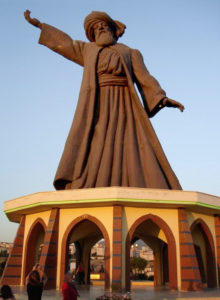
Rumi

o

RUMI


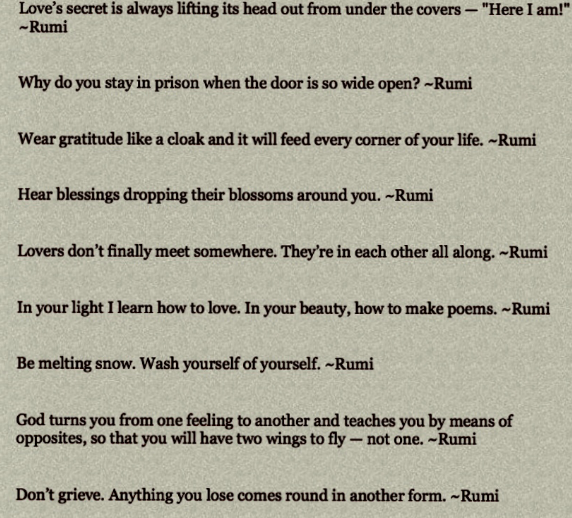
FAMOUS QUOTES FROM THE WORK OF RUMI.

Silence gives answers’

Sufism.

Sufi is the name given to a practitioner of Sufism.  Sufism is a branch of Islam.  Sufism is the mystical, inner dimension of Islam.  Sufi’s form congregations around a master for spiritual meetings.  They believe that they are practicing perfection of worship in the truest original form of Islam.  There are some differing definitions of Sufism within and without Islam, for example, it may be considered a science or a philosophy universal in nature predating the rise of Islam and Christianity.

Some meanings of the word Sufi are; (1) from the Arabic word ” safa” which means purity (2) Suf “wool” which refers to the simple wool cloak worn by the early Muslim ascetics and (3) the word Sufi is derived from the Greek word sofia meaning wisdom.  The basic ideal of the Mystic Sufi is to quell the ego, the self, and through loving ardor for God it is possible to maintain a union with the divine in which the human self melts away.

Jalal-al-Din is the Moslem name of the mystic known as Muhammad Rumi or as he is known in the West, Rumi.  He was born 1207 in a small village in what is now Tajikistan, to native Persian speaking parents.  In the East Rumi is known as Mevlana which means Master.  So revered is this master of words of inspiration, whose quotations and verses have come to us through many centuries that The United Nations declared 2007 The Year of Rumi and celebrations were held worldwide.

Rumi’s father was a brilliant Islamic scholar and fearing a Mongol invasion the family moved to Konya a part of the Turkish Empire. Rumi received his early education from his father, followed by the teachings of top scholars of the time. He was initiated into Sufism through which he pursued the divine truth and immersed his mind and soul into the pursuit of heavenly wisdom and inspiration.

Rumi married and had two sons with his first wife and when, years later she died, he married again and had another son and a daughter.  Although he was a Sufi and a great scholar of the Qu’ran he was noted for his cosmopolitan and tolerant outlook as he studied other religions with care and understanding.  

The daily language of the time was Turkish, the scientific language was Arabic and Persian was the language of literature.  Rumi’s original books are all in Persian. 

Later they were translated into Turkish.  Rumi’s best known book of verse, Masnawi, contains twenty six thousand couplets in six volumes.  In this book there are stories inspired by the teachings of the Qu’ran about all that is created as well as the moral teachings of Mohammad.  Couplets containing few words contain immense wisdom.  The beauty of his poetry transfixes the reader who may then examine the meaning to gain wisdom.  Rumi’s inspiring poetry covers different ideas but the intrinsic theme is the longing and searching for the union within the divine.  

He uses unexpected imagery in his poetry such as ” drunk and intoxicated with ecstasy for his beloved”  in this meaning ” drunk” means bliss and overcoming the self as a means to the divine.  Rumi was a Dervish.  A Dervish  took a vow of poverty and begged so as to learn humility,  any gains had to be given to others.  The whirling dance associated with dervishes was performed to reach religious ecstasy.  In Turkey this is now used as a tourist attraction.  Rumi was a devout Muslim and his teaching of peace and tolerance has appealed to men and women of all sects and creeds from all parts of the world; Muslims, Jews, Christians and others.  Rumi is a point of unity for East and West.

There may be problems in life but Rumi teaches that no one can touch the core of an individual. The evolution of the Soul happens through growth and growth happens through struggle and past experiences.  So, welcome change.  The door for escape and expansion is there from our birth.  Choice exists.  Keep moving because the spark of evolution is timeless.  The open mind is the escape hatch so it is important not to get stuck . 

Rumi tells us that we take the core of experiences with us through life, experience and growth is the purpose of life and this we must share.  We absorb love from others.  The journey of the Soul is to grow in the process and that spirituality is the lifestyle of those on the evolutionary path. 

Rumi claims that the spiritual lifestyle has been turned into a system of control.  He tells us to welcome struggle but to rise above it. 

Rumi tells us that God lives in our hearts…You are God.  Through the struggle of controlling the self and becoming one with God, Wisdom, love and peace evolve in the human heart and soul.

Poems by Rumi

Translated from Persian by Coleman Barks with John Moyne.

The Guest House

This being human is a guesthouse.

Every morning a new arrival.

A joy, a depression, a meanness,

some momentary awareness comes

as an unexpected visitor.

Welcome and entertain them all!

Even if they’re a crowd of sorrows,

who violently sweep your house

empty of its furniture,

still treat each guest honorably.

He may be clearing you out

for some new delight.

The dark thought, the shame, the malice,

meet them at the door laughing,

and invite them in.

Be grateful for whoever comes,

because each has been sent

as a guide from beyond.

Chickpea to Cook

A chickpea leaps almost over the rim of the pot

Where it’s being boiled.

Why are you doing this to me?’

The cook knocks him down with the ladle.

Don’t you try to jump out.

You think I’m torturing you.

I’m giving you flavor

so you can mix with spices and rice

and be the lovely vitality of a human being.

Remember when you drank rain in the garden.

That was for this.’

Grace first. Sexual pleasure,

then a boiling new life begins,

and the Friend has something good to eat.

Eventually the chickpea

will say to the cook,

Boil me some more.

Hit me with the skimming spoon.

I can’t do this by myself.

I’m like an elephant that dreams of gardens

back in Hindustan and doesn’t pay attention

to his driver. You’re my cook, my driver,

my way into existence. I love your cooking.’

The cook says,

I was once like you,

fresh from the ground. Then I boiled in time,

and boiled in the body, two fierce boilings.

My animal soul grew powerful.

I controlled it with practices,

and boiled some more, and boiled

once beyond that,

and became your teacher.’

Who Makes These Changes

Who makes these changes?

I shoot an arrow right.

It lands left.

I ride after a deer and find myself

chased by a hog.

I plot to get what I want

and end up in prison.

I dig pits to trap others

and fall in.

I should be suspicious

of what I want.

A Zero-Circle

Be helpless, dumbfounded,

unable to say yes or no.

Then a stretcher will come

from grace to gather us up.

We are too dull-eyed to see the beauty.

If we say Yes we can, we’ll be lying.

If we say No, we don’t see it,

that No will behead us

and shut tight our window into spirit.

So let us rather not be sure of anything,

beside ourselves, and only that, so

miraculous beings come running to help.

Crazed, lying in a zero-circle, mute,

we will be saying finally,

with tremendous eloquence , Lead us.

When we’ve totally surrendered to that beauty,

we’ll become a mighty kindness.


Bibliography.:

www.wikipedia.org whirling dervishes

YouTube.: sharham shiva

www.rumi.net

Sufism.org

Picture reference.: Faik Sarıkaya 

https://commons.wikimedia.org/w/index.php?curid=1799782


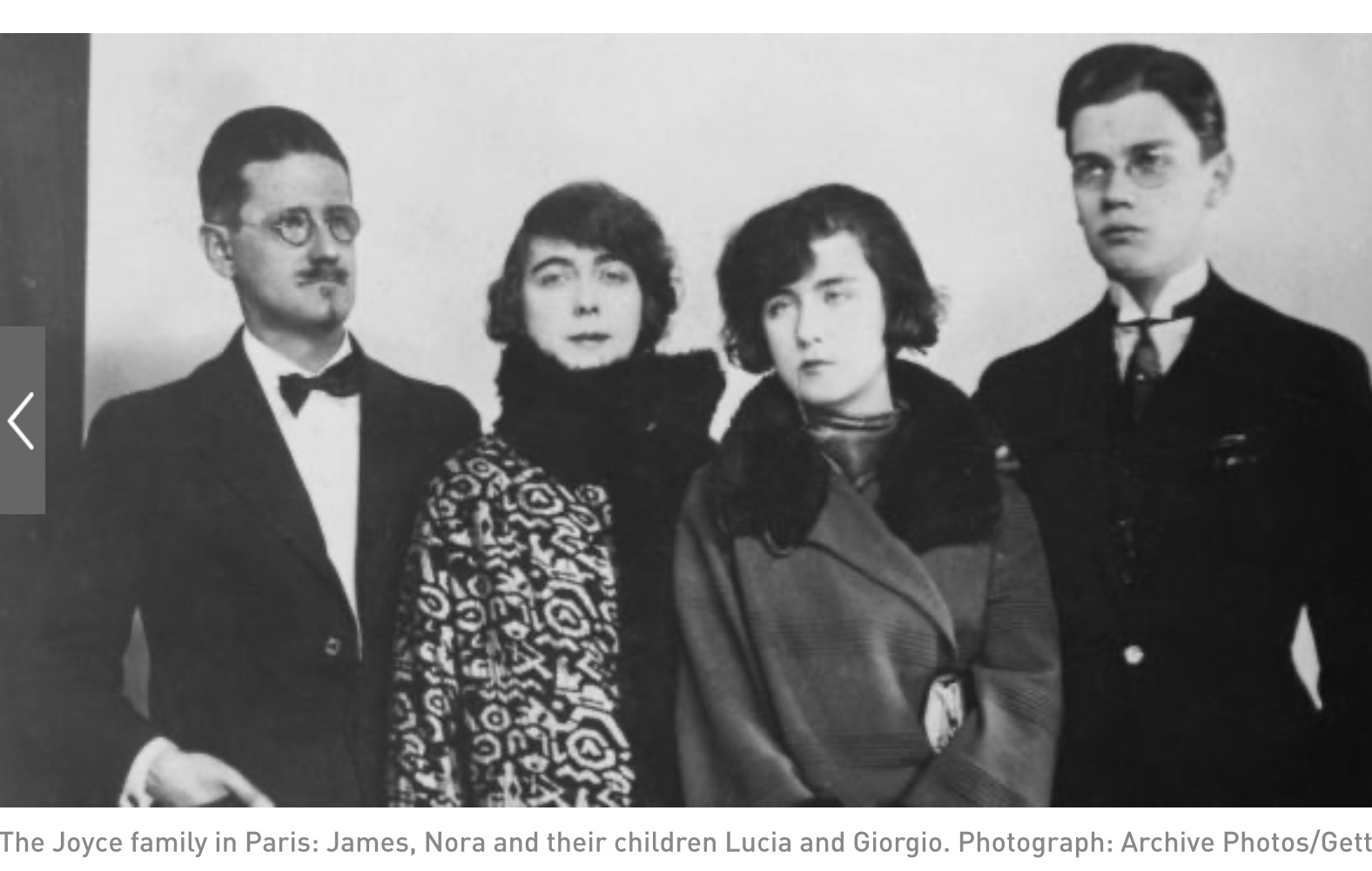
James Joyce

James-joyce-music.com
http://examples.yourdictionary.com/examples-of-lyric-poetry.html

https://en.m.wikipedia.org/wiki/James_Joyce

The Art of Poetry

Birdthistle, Sheighle .Thesis M.A. 2003 James Joyce and the Construction of Self.

“Once upon a time and a very good time it was there was a moocow coming down along the road and this moocow that was coming down along the road met a nicens little boy named baby tuckoo….” (Joyce, 1992:3)

This is a quotation from the novel “ A Portrait of the Artist as a Young Man” by James Joyce and it is the fictionalised story of the life of the author. In his novel, Joyce presents an early sketch of himself in the persona of Stephen Dedalus, from early childhood through the various stages to manhood. This is a good place to begin.

With James Joyce it is good to start at the beginning…Baby tuckoo was the baby Stephen Dedalus and the narrator with the hairy face was his father, Simon Dedalus.

These opening lines of “A Portrait of the Artist as a Young Man” recount the life and genius that was Stephen Dedalus. As Baby tuckoo began to grow from infant to child, history would show that modern Ireland was in its infancy. History would also show how Stephen Dedalus became a renowned artist in the new era of modernity. While still a colony Ireland presented as the Caliban of Europe, the wild man, the Other. It would be difficult therefore for any young man to feel secure in a self that did not seem to conform to the notion of Irish youth as uncouth and uncultured. For someone of the sensitivity, candour and brilliance of James Joyce, it must have been a hell on earth as he struggled with the bondage of ignorance of things modern, that existed in Ireland.

Joyce was not just a great writer but also a great philosopher. His was a philosophy of the artist and his treatise is his work “ A Portrait of the Artist as a Young Man”.

Artistic endeavour, artistic commitment is explained in normal language, a language that flows like a fountain in full force. Joyce used language like breath which is necessary, for both writer and reader but inhaled and exhaled in a unique rhythm.

The Ireland that Joyce was born into was still suffering from the effects of the great potato famines of 1845-1851that had ravaged the country and decreased the population through both death and emigration. This emigration had created another Ireland in Britain and across the Atlantic in America. The Irish in America were instrumental in founding the Fenian Brotherhood from which eventually grew the Irish Republican Army. The Fenian Brotherhood, like the United Irishmen, bound it’s members by oath to secrecy and loyalty to the Irish Republic and was condemned by the Catholic Church. This opposition by the Church was part religious, part political.

It was considered sinful to be a member of a secret society and to forcefully attempt to overthrow the establishment. ( O’ Heithir 2000:43). The Church had achieved power through Daniel O’ Connell and feared that secularisation would deprive it of its hold on the Irish population. When the Land League was formed in October 1879 the Fenians became involved and enjoyed support despite the Church’s opposition.

Parnell through his expert and shrewd work within and outside parliament fought for the recovery of the land for the Irish. The previously unknown tactic of boycotting came into being and was used to great advantage. The Second Land Act of 1881 returned the land to the tenants and ultimately a conservative body of people developed within Ireland. This Act gave tenants the right of free sale and introduced a way of settling disputes resulting from increased rent. Parnell was on the brink of achieving Home Rule when he fell from grace in the eyes of the establishment throughout Britain. The Catholic Church publicly denounced Parnell because of his extra-marital affair with Kitty O’ Shea and Gladstone turned against him when he refused to stand down from the leadership of the Irish Party. In 1891 Parnell died, and his death seemed to increase the bitterness. There then followed a period of stagnation and deterioration of political standards in Irish life and the chance of uniting the people of Ireland as a whole, was lost.

The young James Joyce was nine years old when Parnell died. He was privy to the conversations and discussions of his adult relatives and friends as they argued the rights and wrongdoings of their political and clerical leaders. Within, and outside his family circle he would have observed the docile observance of Rome Rule amongst many while others mourned the loss of personal integrity and commitment.

The Joyce family had a brief time of prosperity before their economic status changed utterly and they sank into poverty, exacerbated by the father’s abuse of alcohol. Against this backdrop James Joyce became the man and writer of distinction.

James Joyce, the man recognises and accepts that he is part of a community; but at the same time he feels isolated from that community. It will be his task to examine that sense of isolation and the way in which it affects his race. Ireland is a colony of Britain but Stephen looks to the future and a time when the people of Ireland will have a voice of their own. He wants to create that voice, uniquely suitable to a people, whose culture is trapped between two languages the Irish language, which is dormant and the English language, which is the language of the coloniser. Stephen wants to create a new rhetoric, a narrative that would invoke the spirit of an independent people, whether colonised or not.

Dublin is the named place in Joyce’s novel but it could be any city in the world. The story told and the problems that are encountered, are personal in this instance, but they are universal ones. Joyce uses the technique of interior dialogue to allow the reader access to the mind of the narrator. At the close of the novel the narrator changes from the third person to a first person account. The author has accomplished what he set out to do; Stephen is self-begotten as he welcomes life and the experience of reality. The technique used by Joyce in “A Portrait of the Artist as a Young Man” laid the foundation for his masterpiece, Ulysses.

James Joyce and the music of poetry.

Poetry was first an oral art, heard and listened to, before It became a written art. The music of poetry is its rhythm and rhyme and, of course its choice of form and subject matter.

The medium for a poem is the voice and each of us has a distinct personal voice with which to interpret the words of a poem. Poetry comes from the imagination and is presented in the language of the poet – transformed and honed and then voiced. The sound of the words, their placement and the voice of the reader all combine to make a poem. Think, and remember how clearly a piece of music can relay a vivid memory to the mind – physical emotion is activated and we can feel as though transported to another time and place.

When a poem is spoken aloud it has a similar power – it is always wise and necessary to read poetry, it is like food for the imagination, body and soul. When we recite the poem we have a potent piece of music with an imagined visibility – we can form pictures in the mind and present them aloud. Using these images we can recite a poem with feeling and understanding. Add to that, memorising the words enhances the experience. Reciting from memory excludes the interruption or intervention of having to read the poem from a book.

Reading poetry can be difficult and needs time and concentration and an understanding of the poem, in order to do it well. Memorising a poem helps to provide a better voicing. The poem finds its life its reality when shared between the speaker and the listener. The poem has its own identity and escapes ownership of the poet when it has a reader or a listener. The poem arrives as words placed together. When we read these words and read them aloud we form an understanding. The sounds and pauses are all directly involved in the meaning of the poem. Spoken or read aloud enables us to follow the music of the poem allows us to make a connection with the poem on an emotional level or intellectual level, or both. Listening, to another person reading enables a human connection and allows the words of the poem to sink into the consciousness

James Joyce. (1882-1941)

James Augustine[1] Aloysius Joyce (2 February 1882 – 13 January 1941) was an Irish novelist, short story writer, and poet. He contributed to the modernist avant-garde and is regarded as one of the most influential and important authors of the 20th century. The following poems are from one of his two collections of poetry.

The particular collection from which I have chosen, has been put to music by a number of composers.

In 1907, shortly after publishing a book of love poetry titled Chamber Music, Irish writer James Joyce penned a letter to his brother Stanislaus: “Some of the verses are pretty enough to be put to music. I hope someone will do so, someone that knows old English music such as I like.” A century later, a group of independent electronic, folk and rock musicians have done just that.

All 36 verses from Joyce’s book of poetry have been put to music by artists such as Peter Buck from R.E.M. and Lee Ranaldo from Sonic Youth. Producer James Nichols got the idea a few years ago while thumbing through Joyce’s poetry in a bookstore. He was so intrigued that he decided to find out more about the obscure collection of verses. He wasn’t the first:

Chamber Music

Strings in the earth and air
Make music sweet ;
Strings by the river where
The willows meet.

There’s music along the river
For Love wanders there,
Pale flowers on his mantle,
Dark leaves on his hair.

All softly playing,
With head to the music bent,
And fingers straying
Upon an instrument.

According to Ezra Pound ;
‘The quality and distinction of the poems in the first half of Mr Joyce’s Chamber Music … is due in part to their author’s strict musical training. We have here the lyric in some of its best traditions….’. In lyric poetry, the mood is musical and emotional. The writer of a lyric poem uses words that express his state of mind, his perceptions, or his feelings.

Pound goes on to note poem V111…Here, as in nearly every poem, the motif is so slight that the poem scarcely exists until one thinks of it as set to music; and the is so delicate that out of twenty readers scarce one will notice its fineness.

Who goes amid the green wood
With springtide all adorning her?
Who goes amid the merry green wood
To make it merrier?

Who passes in the sunlight
By ways that know the light footfall?
Who passes in the sweet sunlight
With mien so virginal?

The ways of all the woodland
Gleam with a soft and golden fire —
For whom does all the sunny woodland
Carry so brave attire?

O, it is for my true love
The woods their rich apparel wear —
O, it is for my true love,
That is so young and fair.

I choose to mention these two poems by Joyce because, in my opinion, here we have, what is called ‘the chicken and egg dilemma’ that is, which is first, or which is of greater importance. The words or the music of the words. In the poem, Strings in the earth and air make music sweet ; we are struck by the imagery of the words that immediately conjour up a poetic situation as if we could hear the sweet music of violins wafting through the air on an idyllic river walk. The metaphor of Love wandering alongside us bedecked with flowers adds to the musical scene, as he picks out music from his instrument.

James Joyce is known as a brilliant writer, however there was a part of Joyce that almost had an career as as a musician. Joyce’s training and musical skill, his love and appreciation of all types of music, infiltrated his writing in many ways. Joyce had a beautiful tenor voice richly clear and not at all strident. His relationship with both language and music greatly influenced his writing and especially the poetry of Chamber Music, which was written as a collection of love poems. Chamber Music was in fact, Joyce’s first published book in the year 1907. His second collection of poems Pomes Penyeach was published in 1927.

The music in the writings of James Joyce continues to entertain the world throughout the ages and gives us the readers, nutritious food for thought.

The Art of Reading and Writing Poetry

The Poetry Corner. May 2020

Poetry is for everyone. Not everyone chooses to be a poet and some consider poets to be pretentious and suspiciously obscure and yet in times of great joy or great grief or danger poetry becomes for many a secure haven. Poetry was being composed long before the written text existed and the fact that we are reading, listening, watching and performing poetry in the twenty first century surely makes a statement. Poems are always there, whether understood or not, but they are there to be enjoyed and given life. This life is conceived and birthed when the reader chooses to read the poem and ingest it with a personal understanding. A poet is a maker; the word poet comes from ‘ poiein,’ the Greek word for maker. The poet makes something from language; he chooses words, shapes them, pours emotion all over them and forms them into a poem.

Michael Longley, an Irish poet contemporary of Seamus Heaney, wrote,

” If I knew where poems came from, I’d go there.” I suggest that it is possible to find that place, it is within everyone of us, as the song sings we are all ” poetry in motion.” All we need to do is write it down and actually write it out of the conscious or subconscious. Then we awake to the people that we meet through friendship or accidentally and we become more aware of their voices and needs.

Heeding the needs of others often soothes our own hunger. In this poetic mode, streets buildings and sounds have a life of their own and of course nature’s colours are more vivid and startling. The beauty of love, the hurt of grief, the ache of stress are part of this concrete life that we all live. We can try to deal with all these issues through poetry and learn about ourselves through writing down our thoughts. Naturally, we hope that all our thoughts are happy ones full of fun and laughter and peace. Peace; Inner Peace, Family Peace, World Peace and finally, the kind of peace that settles us human beings, with a sense of calm and happiness. Award winning Portuguese poet Sophia de Mella Breyner Andressen explains ; “Poetry is my way of understanding the universe, my way of relating to things, my participation in reality.” We can try, and it can make a difference, the poet is a maker and not all things that are made, are perfect, so poetry is there waiting within us all, to be shaped and given a life by each unique poet.

The way we can read and write poetry today is due to the huge change wrought by Modernism at the beginning of the Twentieth Century. The change had started at the height of the Romantic Era when Wordsworth and Coleridge revolutionised poetry. These poets brought poetry within the reach of the average man and woman by writing in everyday language. Poetry was now the living voice. Poetry went through subtle changes through the Victorian Era, the Georgian Era, and various movements until a world, changed by the Industrial Revolution and The First World War gave birth to Modernism. Poetry is like life, it changes and changes. Modernism shattered fixed conventions that stated that only specific language and subjects were poetic. A melange of magnificence was created by calling on other cultures and by mixing alien and ancient materials. Picasso did this with the art of painting, mixing textures and introducing collage and fragmentation into painting. These changes advanced by Modernism also changed the popular audience for poetry. Some readers resisted the changes and preferred mainstream, easy to understand, poetry.

There is movement of thought and words in poetry so we read and move on through the poem. T.S. Eliot said ” We learn what poetry is – if we ever learn – from reading it.” The poet has crafted a poem within which words will delight or destroy the anticipation of the reader. A poem should stand free of intellectual examination and be interesting and good to read. If therefore, the words on the page please, the first step towards satisfaction is underway. The next thing to note is the form or shape of the poem. Is it a sonnet or a lyric poem? Is it a free verse or a rhyming poem? Everyone has a preference and may be attracted by a specific type of poem…it may simply be the length of a poem that attracts. Sometimes we want to read a short poem another time we require a fuller longer piece of poetry. There is, in fact an explanation for the reason for choosing a short poem, such as, the sonnet. The human brain is such that the fourteen lines of the sonnet suit the human psyche.  The ingenuity of its form contains the phenomenon of the golden section or the golden ratio.This fact is extremely interesting not only to mathematicians but to all of us who seek to know “the reason why” or the natural explanation of things that we take for granted. Poetry suits the changing mind. Next, does what the poet is trying to say make sense to the reader and is there a sense of agreement, appreciation or disapproval. Is there a premise in the poem that requires further study, are moral issues being interrogated?

All the above are considered like the interior of the human body. We see only the exterior body and we are either attracted or disinterested. When attraction occurs one continues the conversation. Same with poetry, it is possible to fall in love with a poem, just for itself, long before inquiring into its reasons it’s matter and explanation. We try to understand a poem through our personal knowledge and what we have learned without and within the particular poem. Like life, and living, we need to participate in the poem and bring it to life so that we seem to live in it.

Sometimes we find ourselves lost as we encounter difficulties of hidden nuances or the twists and subtleties of the words. Reading and re reading is the key. Poems can describe and try to explain life. If a poem sparks a thought or a memory in the reader the meaning in the poem may change, and become the reader’s version. The reader may take the poet’s words and see something new and exciting. That is the wonder of poetry. When we first read a poem, we need to like it and find something that makes another reading attractive. It may be the sound within the poem, its music or its whispering memories. It may simply be, how it looks on the page. Does the poem appeal to the senses? We need this reaction before looking for meaning.

Here are some useful tools that we can use to examine a poem and try to reach an understanding and add to our enjoyment of poetry.

Imagery;
Imagery is use of descriptions that appeal to the reader’s five senses. ie. The scent of a rose. The sound of the sea.

Metaphor;
Metaphor is a comparison between unlike things. ie.The poetry of her life was a sonnet.
The wine is heavenly.

Simile;
Simile is the same as metaphor but employs the use of ‘ like’ ie It is like the scent of a rose.
It is like the sound of the sea.

Personification;
Personification is giving human characteristics to animals or non human things. ie. The trees listen to my words. The house knows when we are home.

Patterns; Repetition of words or phrases.

Feelings; Atmosphere of the poem.

Puzzles; Something or mysterious in the poem.

These definitions are useful when reading, and especially, when reviewing a poem. There are, of course many aspects of a poem to consider and that is why so many reviews differ. This is wholesome, as each reader may have a different interpretation

A critique of a poem from “The Toga and The Rose”. The Hand of God Gloved.

The Hand of God Gloved

A life that should have been yellow, coloured grey.
Cotton fields blazing sun and laughter
Singing in the cloisters like angels
The man swung his belt and blasted
The beauty from all time
As innocence lost its rhyme
They found a new reality.
A life that should have been yellow, coloured grey.
Black skin the only sin
Eyes dark as the blood soaked earth.
As the light dimmed and died
The singing in the cloisters of demons
Rattled the chains
Of hunger and thirst
A life that should have been yellow, coloured grey
Is now black.
The hand of god gloved.

I walked into a meadow
And asked a man for gold
He said that I was ugly
And that I should be sold
For half a pint of nothing.
A life that should have been yellow, coloured grey.
I was the Devil’s Agent, he said.  He took the child away.
The well is deep.  How harsh the sleep
There is no anodyne for pain
The constant gnawing strain
For a life that should have been yellow, coloured grey.
The hand of god still gloved.

(c)2014 Sheighle Birdthistle (The Toga and The Rose)

Attention is immediately drawn to the title of the poem. A gloved hand lacks intimacy so the inference is of a God who is distant or uncaring. The poem opens, telling of a life that should be happy ..yellow is a bright colour think of sunshine and warmth, but here we have a metaphor for a life no longer happy. The colour grey…dullness, drab grey, colours this life with misery instead of happiness. Then we have the simile of the person or persons singing like angels as the tone changes suddenly and we realise through the use of the plural pronoun that the life being lived is more than one. The cruelty of the man takes away the innocence of those singing as they realise that their reality is indeed grey and without joy. The repetition of the line “a life that should have been yellow, coloured grey” serves to state firmly the damage being done. Over and over again.

We know now that this first stanza is about abuse, global abuse of race. “Black skin the only sin” We read of hunger and thirst and the spilling of blood and the only reason is the colour of those at work in the cotton fields.

The second stanza is told in the first person making the conversation with the reader a personal interaction. “I walked into a meadow and asked a man for gold”. Walking into a meadow, a field of grassland often covered with wild flowers sounds gentle and easy but this premise is quickly shattered by the man’s reaction. Asking for gold…this is a metaphor for help, for assistance. But his response “half a pint of nothing” is that “I” am worthless …devoid of all respect …the Devil’s Agent.
“I” am the temptation that cannot be resisted, but he is the one who destroys the innocent without remorse. There is no solution for the abused, the depressed for the tortured sleeplessness of the injured. This person longs for a life that should have been a normal happy life. It is still a damaged grey because the hand of God is still gloved. The poem closes as it opened with a metaphor of colour for the good, and the bad, experienced in life. “A Life that should have yellow coloured grey.”

Some poems for you to enjoy.

Undiluted dismissal …

Oh to be and not to be
when too tired to try
To please the world
Or the little world
Of those you love
Unresisting the slights
Expiring the breath
Of undiluted dismissal
And losing it, losing it
As night snores on you
And the moon seems to
Cloud over and sneer
Oh to be and not to be
When tomorrow may
Put on it a different
Veneer of life or death
And it might be too late
To care whether or not
It matters or not
To be or not to be.


(c) Sheighle Birdthistle.

The Kiss

The sea is a flirtatious lover
It rolls in and kisses the rocks
Rolls out again waving gently

In those moments I glimpse eternity
On it goes its power exploding
Like the love in my broken heart

My gaze takes flight  beholds a ship
My soul finds its wings to rest aboard
And sail safely in the ocean’s kiss

(c) Sheighle Birdthistle

Disconnected

She looks out through the window pane
Sea and sky have blended to one
Yachts moored with tall moaning masts
In the harbour of discontent
Reflect the feel of the nation
And the blasting inertia rains on limbs.
As the wealthy prepare to sail.
The sunrise is perfect delight
Sunset is a fire raging mad
Class war is hidden in purple rage
As nations pretend to vote again.

Sheighle Birdthistle.

Reference.
Bibliography.
Astley, Neil (Ed.,) 2002 Staying Alive real.poems for unreal times Bloodaxe Books Ltd.

Highgreen, Tarset, Northumberland.NE48 IRP. UK.

Poems

I Am a Whisper in the Wind

Who am I….what am I?
So unlike the others
That I have become
The other….that one
Who does not agree
With the words voiced
Or thoughts unveiled

The idea of being
Matter in existence
Relenting my essence
Of spiritual thinking
Existing in the mundane
No more I; who am I?

I am a whisper in the wind.
Sheighle Birdthistle.

The Poetry Corner April 2020 William Wordsworth

The Poetry Corner. April.

William Wordsworth. (1770-1850)

William Wordsworth was born on 7th. April 1770 Cockermouth, Cumberland. Cockermouth is a little town in the north west of England, in the region known as the Lake District.

He was the second of five children born to his parents, John and Ann. There were four boys and one girl, Richard, William, Dorothy, John and Christopher. William had a wild and free, happy childhood. He played on the banks of the river Derwent which bordered the garden of the family home. William’s happy childhood is beautifully told by the twenty nine years old Wordsworth in The Prelude.

I, a four year’s child,

A naked boy, among the silent pools

Made one long bathing of a summer’s day,

Basked in the sun, or plunged into thy streams,

Alternate, all a summer’s day, or coursed

Over the sandy fields, and dashed the flowers

Of yellow grunsel: or, when the crag and hill,

Were bronzed with a deep radiance, stood alone

A naked savage in the thunder-shower…

The family home was an impressive building in the main street of the little town and its garden was bordered by the river Derwent. Wordsworth’s father John worked as a law agent to Sir James Lowther, the most powerful man in the district. Sir James later became the first Earl of Lonsdale; he was a prominent politician and was also considered to be one of the most hated tyrants in England at the time. John and Ann Wordsworth and their family lived rent free in this house owned by Sir James.

William and Dorothy spent long periods of time with their maternal grandparents and the children received only a little formal education. William attended an infant school while with his grandparents and Mary Hutchinson was also an infant pupil. Wordsworth married Mary many years later. Back in Cockermouth, he attended Reverend Gilbank’s grammar school. William’s father introduced him to the important and best works of English poetry. At a very young age William could recite by heart, large portions of Shakespeare, Milton and Spenser.

In 1778 the Wordsworth family was devastated, disrupted and displaced when Ann Wordsworth died of pneumonia. Her death caused the separation of the children and the loss of their home. Dorothy, who was six years old at the time of her mother’s death, went to live with her mother’s cousin in Halifax where she subsequently grew up. She, Dorothy and her brother William did not meet again for nine years. Richard and William were sent to stay with a childless couple, Ann and Hugh Tyson, so that they could attend grammar school at Hawkshead. Eventually, the three Wordsworth brothers and a cousin became part of the Tyson household.
The eight years spent there were very happy years for William.

Growing up in Hawkshead provided a good education for Wordsworth. He realised the worth of the normal ordinary people with whom he had contact. He appreciated the value and stability of the farm labourers, shepherds, blacksmiths, shopkeepers and innkeepers and the ferrymen on Lake Windermere. He recognised the necessity of continuity of work for a good society. Wordsworth observed society from an early age not only through the lives of those people with whom he interacted, but also by his interaction with Nature. Although his school day was long he loved to ramble and gather nuts in the woods, to discover raven’s nests and he loved fishing and skating. Wordsworth wrote “‘twas my joy, to wander half the night among the cliffs or to get up at the first hour of the morning and be at one with Nature”.

At school he studied Latin, Greek. Mathematics Science and Natural Philosophy, English, French and dancing. He had access to his father’s collection of books and to the school library. He read voraciously. His two headmasters loved poetry and lent him books. He was encouraged to write while at Grammar School and one of his earliest poems, inspired by the setting of the sun was written when he was fourteen years old. At this young age, he realised that poets had ignored Nature as a subject. He determined to fill that poetic void.

William was thirteen when his father died and the children once more suffered a sense of isolation. The children were now under the guardianship of two uncles who had a hard struggle against Sir James to acquire the inheritance for the children. During the following school holidays Wordsworth spent time with his grandparents in Penrith but the relationship was not a happy one. When he was seventeen and Dorothy sixteen, they were reunited and spent the summer rambling and they were joined by Mary Hutchinson, Wordsworth’s future wife. Later that year, William Wordsworth left the Lake District for the first time to study at Cambridge University.

In 1787 Wordsworth entered St. John’s College Cambridge but he was unsettled by the worldliness of the University and its intellectualism. He disliked competitive examinations and spent more time socialising than studying. He was awarded a pass degree in 1791. In 1790 the summer of his final year in University, Wordsworth and his Welsh friend, Robert Jones went on a walking tour through France and Switzerland. They described France, as a nation “mad with joy” as it celebrated the first anniversary of Bastille Day.

Wordsworth was now twenty one and the year was 1791. He rejected a career in law or the church and spent January to May in London. He read extensively and attended debates in the House of Commons and he became more politically aware. He had been greatly influenced by the French mood of Revolution and the concept of equality. From the time of his father’s death and the ensuing family problems, Wordsworth had become aware of the injustices suffered by people. He was conscious that revolution was a valid proposition

Wordsworth decided to cross the channel to France both to improve his French and to see for himself the effects of the 1789 Revolution. It was in Orleans that he met and was attracted to Annette Vallon who was a Catholic and four years his senior. Soon Annette was pregnant with Wordsworth’s child. His daughter, Anne-Caroline was born 15th. December 1792 but, earlier that year, the previous October, Wordsworth had left Annette and went to stay in Paris. He had returned to London by the end of December. Critics argue that Paris during this period was too interesting politically to be missed or, that Wordsworth was awaiting his passport. Annette expected Wordsworth to marry her and her letters were full of longing for his return. Furthermore, the outbreak of war between England and France made a union between Annette and William more unlikely.

Professor George Mc Clean Harper of Princetown University published in 1921 ” William Wordsworth, his life.” The Professor had received credible papers in 1917 confirming the birth of Annette Vallon’s daughter Anne-Caroline and naming William Wordsworth as the father, which he acknowledged. She was named Caroline Wordsworth and it was with this name that she married her husband in later years.

William Wordsworth realised that unlike France, England would not tolerate dissent. He wrote a piece arguing that not only the British Monarchy but the aristocracy should be abolished. This was never published during his lifetime. About this time Wordsworth published two poems. “An Evening Walk” and “Descriptive Sketches” but neither was well received.

Once more William set out with a friend, William Calvert on a tour of the West Country. During this tour he stopped at Tintern Abbey before continuing up through Wales. Soon after, William Calvert offered Wordsworth and his sister Dorothy, a farm, Windy Brow, a farm surrounded by natural beauty. Here William and Dorothy led a simple and contented life drinking milk, not tea and eating chiefly potatoes. While Dorothy studied French and Italian, Wordsworth was rewriting and revising his poetry.

William Calvert’s younger brother was dying from tuberculosis and he bequeathed William Wordsworth the sum of 900 pounds in his will. This belief in his poetry was a great boost for Wordsworth. While awaiting the payment of this inheritance Wordsworth spent time with various friends and while in Bristol he met Samuel Taylor Coleridge. This was the beginning of a life long friendship…Coleridge was one of the many radicals who supported the French Revolution that Wordsworth encountered. Wordsworth and Dorothy were given Racedown Lodge rent free and it was arranged that they would look after a young boy, Basil Montagu. While were they living at Racedown Lodge there were many protests by Liberals against the government. The king’s coach was attacked as he was on his way to the state opening of Parliament. Wordsworth in his poem “Imitation of Juvenal”attacked those who were powerful and wealthy, but corrupt. His Play The Borderers was rejected by Covent Garden and he found it difficult to get his work published. From Racedown they moved to Alfoxden house, a beautiful mansion among the Somerset Hills so as to be close to Coleridge and his family.

The three friends loved to ramble about the countryside observing nature and taking notes, so much so that they were investigated by the Home Office. Eventually they were asked to leave Alfoxden due to their association with Coleridge and other radicals and because of Wordsworth’s political beliefs. The Wordsworth’s left Alfoxden late June 1798 and continued their rambling and exploring and spent some time in Germany with Coleridge and another friend John Chester. 1797-1798 marked a very important development for Wordsworth and Coleridge. The publication of the Lyrical Ballads on the 4th of October was a turning point in English poetry. The poems were totally different to the poetry of the time and were a collaboration between the two poets. Wordsworth wrote nineteen of the twenty four poems in Lyrical Ballads. This book of poetry was a new departure in English literature. The language of the poems was the language of conversation; the subject matter was human characters and human incidents. There were poems about beggers, a mad mother, and an idiot boy. Wordsworth intended to write about the world and the people who existed in that reality. His intention was to alter people’s perceptions, not only of poetry but of how they viewed their fellow man.

Wordsworth had begun writing Books 1 and 2 of The Prelude while in Germany. The Prelude ultimately consisted of fourteen books and was sub titled ‘the growth of a poet’s mind’. He remembers the Stolen Boat and Skating and many of the Lucy poems including “A slumber did my spirit seal”. The Lucy poems are an enigma; No one knows the true meaning or identity. Critics argue that Lucy is either the universal reader or the poet’s sister Dorothy. Lucy may be an imaginative tool, the muse to whom the poet spoke.

The Wordsworth’s returned to the Lake District and set up home in Dove Cottage, Grasmere. Wordsworth celebrated the locality in his poems and was idyllically happy with the hills and lakes and rivers of the area. Later Coleridge and his family moved to the Lake District, Wordsworth’s brother John came to visit as did Mary Hutchinson and a period of happiness prevailed.

In 1800 Wordsworth prepared another edition of Lyrical Ballads which excluded Coleridge and caused some unease in their relationship…These new poems were inspired by “low and rustic life”. Wordsworth wanted to show that “men who do not wear fine clothes can feel deeply” He was obsessed with revising his work and did so continually. This compulsion caused him illness fatigue and sleepless nights.

Wordsworth and Mary Hutchinson fell in love and decided to marry on October 4th. 1802. Before doing so, William and Dorothy travelled to France to visit Annette and his daughter Caroline who was now nine years old. Wordsworth wrote “It is a beauteous evening, calm and free” in which he expresses his feelings for Caroline, but little else is known of their relationship.

William and Mary had a happy marriage and a family of six children. His reputation as a poet was growing and once again his relationship with Coleridge was troubled. Coleridge disapproved of Wordsworth’s short poems and Wordsworth disapproved of Coleridge’s neglect of his family. This was a very productive period of his life and it was in 1804 the year that Wordsworth’s daughter Dora was born that he wrote his famous poem that would make him known throughout the world.

I Wandered Lonely as a Cloud

I wandered lonely as a cloud

That floats on high o’er vales and hills,b

When all at once I saw a crowd,

A host, of golden daffodils;

Beside the lake, beneath the trees,

Fluttering and dancing in the breeze.

Continuous as the stars that shine

And twinkle on the milky way,

They stretched in never-ending line

Along the margin of a bay:

Ten thousand saw I at a glance,

Tossing their heads in sprightly dance.

The waves beside them danced: but they

Out-did the sparkling waves in glee:

A poet could not but be gay,

In such a jocund company:

I gazed – and gazed – but little thought

What wealth the show to me had brought:

For oft, when on my couch I lie

In vacant or in pensive mood,

They flash upon that inward eye

Which is the bliss of solitude;

And then my heart with pleasure fills,

And dances with the daffodils.

The subject is the natural world particularly daffodils and it is a celebration of memory. Wordsworth shows us, the reader, the connection between what we see before us, how we see again through the power of memory and imagination and how we can store up the present moment for pleasure and comfort in the future.

By 1805 Wordsworth had completed the first draft of The Prelude and many specialists consider that Wordsworth had written his best poetry by then.

At the age of seventy three Wordsworth was appointed Poet Laureate. He was conservative and a churchgoer in later life the opposite of what he had been as a young man. He continued to plant trees and to walk at all times of the year. In 1850 William Wordsworth contracted pleurisy and died on 13th. April. He is buried in Grasmere churchyard, one of the world’s most visited literary shrines.

Bibliography.

Mac Monagle, Niall ed., 2009 Poetry Now. The Celtic Press. Dublin 8.

Birdthistle, Sheighle 2003 University notes. Ireland.

Ousby, Ian, ed., 1994. The Wordsworth Companion to Literature in English. Wordsworth Editions Ltd., Cumberland House, Crib Street, Ware. Herfordshire SG12 9ET

William Wordsworth.

I Wandered Lonely as a Cloud. (C.1804 P.1807) page 219

Ode. Intimations of Immortality from Recollections of Early Childhood. (C.1803 P.1807) page 701

Composed Upon Westminster Bridge, September 3, 1802 (C.1802 P.1807) page 320

Untitled. Strange fits of passion have I known. (C.1799 P.1800) page 125

Power of Music. (C.1806 P. 1807) page 220

To a Butterfly. (C.April 20th.1802 P. 1807) page 122

She was a phantom of delight. (C.1804. P.1807) page 217